


Page 26 - Demo
P. 26
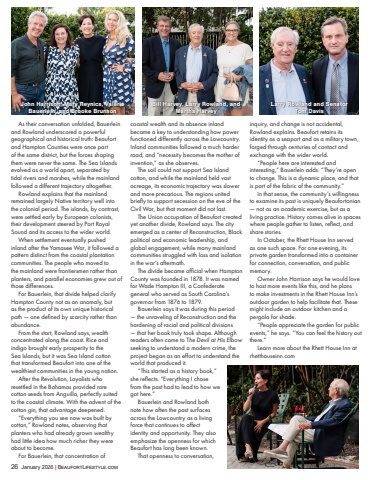
26 January 2026 | BeaufortLifestyle.com As their conversation unfolded, Bauerlein and Rowland underscored a powerful geographical and historical truth: Beaufort and Hampton Counties were once part of the same district, but the forces shaping them were never the same. The Sea Islands evolved as a world apart, separated by tidal rivers and marshes, while the mainland followed a different trajectory altogether. Rowland explains that the mainland remained largely Native territory well into the colonial period. The islands, by contrast, were settled early by European colonists, their development steered by Port Royal Sound and its access to the wider world. When settlement eventually pushed inland after the Yamasee War, it followed a pattern distinct from the coastal plantation communities. The people who moved to the mainland were frontiersmen rather than planters, and parallel economies grew out of those differences. For Bauerlein, that divide helped clarify Hampton County not as an anomaly, but as the product of its own unique historical path %u2014 one defined by scarcity rather than abundance. From the start, Rowland says, wealth concentrated along the coast. Rice and indigo brought early prosperity to the Sea Islands, but it was Sea Island cotton that transformed Beaufort into one of the wealthiest communities in the young nation. After the Revolution, Loyalists who resettled in the Bahamas provided rare cotton seeds from Anguilla, perfectly suited to the coastal climate. With the advent of the cotton gin, that advantage deepened. %u201cEverything you see now was built by cotton,%u201d Rowland notes, observing that planters who had already grown wealthy had little idea how much richer they were about to become. For Bauerlein, that concentration of coastal wealth and its absence inland became a key to understanding how power functioned differently across the Lowcountry. Inland communities followed a much harder road, and %u201cnecessity becomes the mother of invention,%u201d as she observes. The soil could not support Sea Island cotton, and while the mainland held vast acreage, its economic trajectory was slower and more precarious. The regions united briefly to support secession on the eve of the Civil War, but that moment did not last. The Union occupation of Beaufort created yet another divide, Rowland says. The city emerged as a center of Reconstruction, Black political and economic leadership, and global engagement, while many mainland communities struggled with loss and isolation in the war%u2019s aftermath. The divide became official when Hampton County was founded in 1878. It was named for Wade Hampton III, a Confederate general who served as South Carolina%u2019s governor from 1876 to 1879. Bauerlein says it was during this period %u2014 the unraveling of Reconstruction and the hardening of racial and political divisions %u2014 that her book truly took shape. Although readers often come to The Devil at His Elbowseeking to understand a modern crime, the project began as an effort to understand the world that produced it. %u201cThis started as a history book,%u201d she reflects. %u201cEverything I chose from the past had to lead to how we got here.%u201d Bauerlein and Rowland both note how often the past surfaces across the Lowcountry as a living force that continues to affect identity and opportunity. They also emphasize the openness for which Beaufort has long been known. That openness to conversation, inquiry, and change is not accidental, Rowland explains. Beaufort retains its identity as a seaport and as a military town, forged through centuries of contact and exchange with the wider world. %u201cPeople here are interested and interesting,%u201d Bauerlein adds. %u201cThey%u2019re open to change. This is a dynamic place, and that is part of the fabric of the community.%u201d In that sense, the community%u2019s willingness to examine its past is uniquely Beaufortonian %u2014 not as an academic exercise, but as a living practice. History comes alive in spaces where people gather to listen, reflect, and share stories. In October, the Rhett House Inn served as one such space. For one evening, its private garden transformed into a container for connection, conversation, and public memory. Owner John Harrison says he would love to host more events like this, and he plans to make investments in the Rhett House Inn%u2019s outdoor garden to help facilitate that. These might include an outdoor kitchen and a pergola for shade. %u201cPeople appreciate the garden for public events,%u201d he says. %u201cYou can feel the history out there.%u201d Learn more about the Rhett House Inn at rhetthouseinn.comBill Harvey, Larry Rowland, and Martha HarveyJohn Harrison, Mary Reynics, Valerie Bauerlein, and Brooke BrunsonLarry Rowland and Senator Tom Davis


