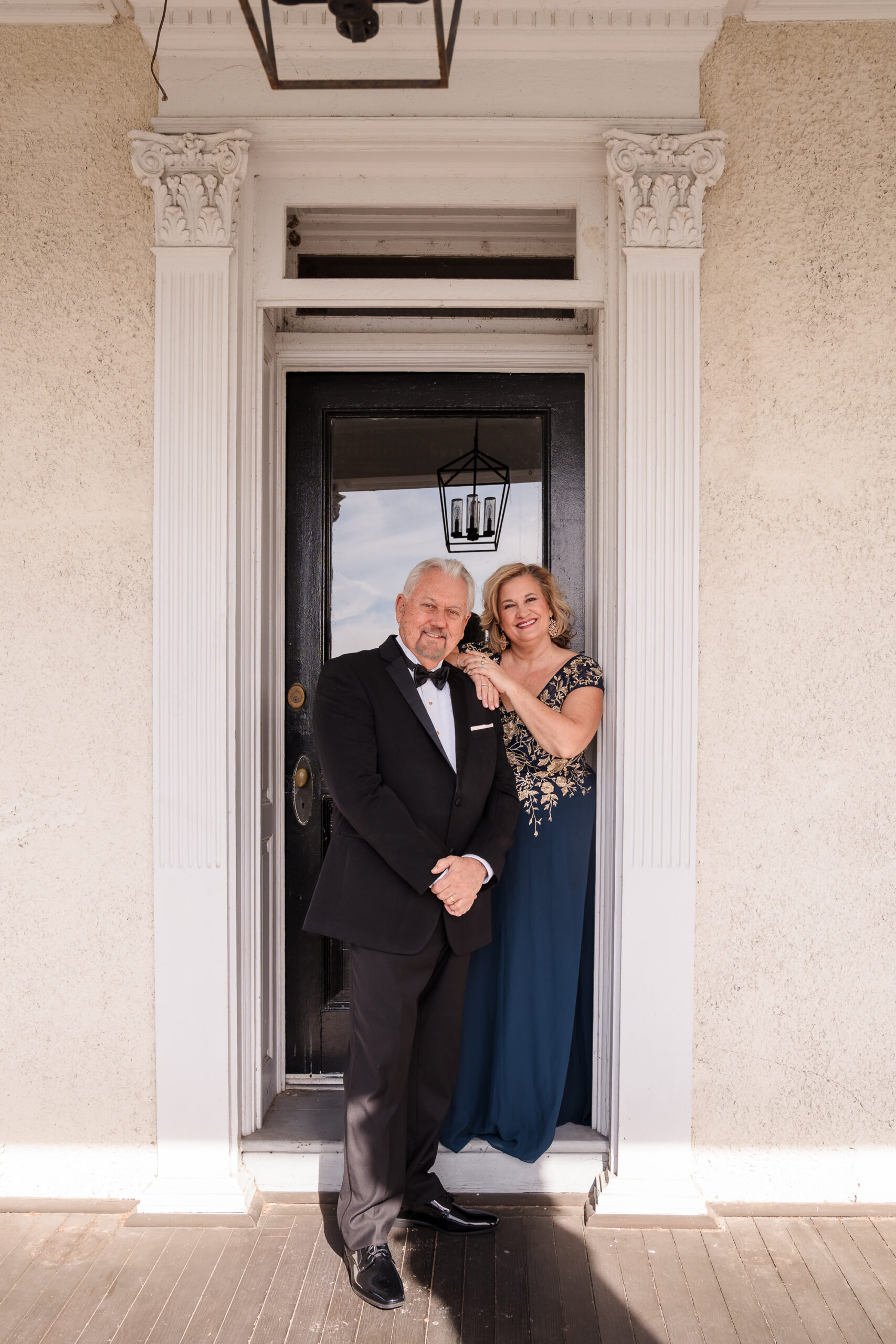
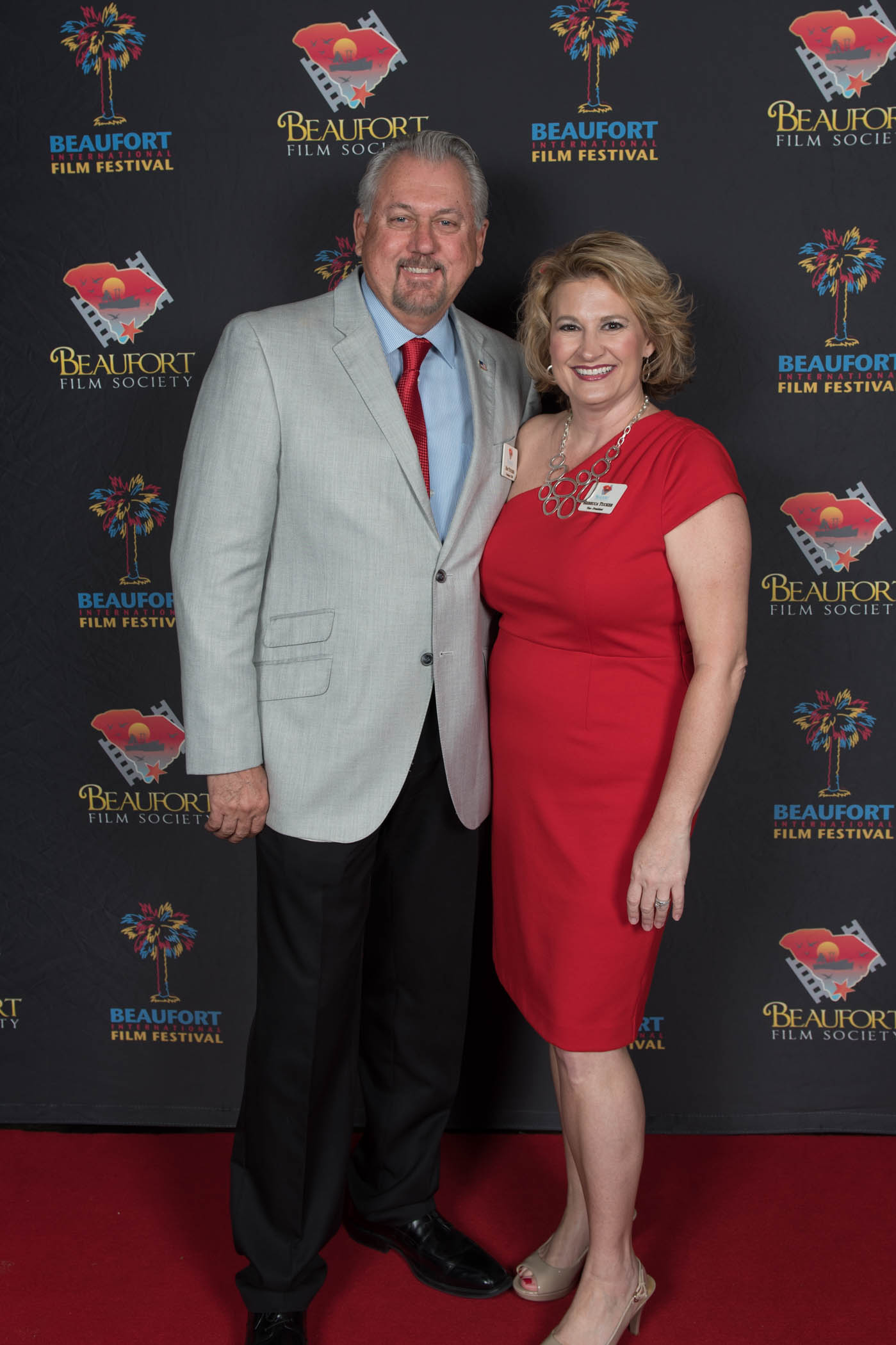
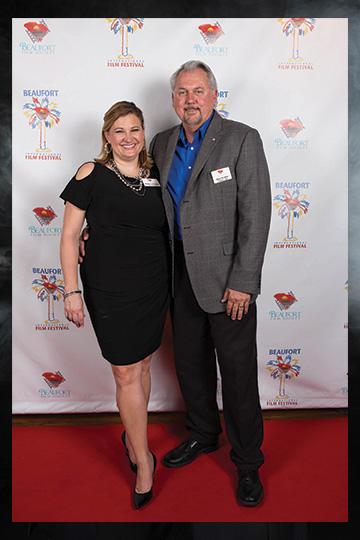
Ron and Rebecca Tucker
THE COUPLE WHO BUILT BEAUFORT INTERNATIONAL FILM FESTIVAL
story by HEATHER STEINBERGER photos by SUSAN DELOACH
Applause, cheers and whistles thundered through the University of South Carolina Beaufort Center for the Arts as a white-haired gentleman took the stage. He hugged actor Blythe Danner, who presented him with the Beaufort International Film Festival’s Jean Ribaut Award for his contributions to film, and then surveyed the gathered audience with a familiar twinkle in his eye.
“I have never regretted one single thing, one single moment of being in this town,” said author Pat Conroy, his affection for the community unmistakable in video footage from the festival’s 2010 awards ceremony. “That Blythe Danner and Michael O’Keefe came back to celebrate this is simply another miracle this town keeps throwing at me as I live my life here.”
Conroy has been gone for nearly a decade, but Beaufortonians still remember that special night when they welcomed a reunion of stars from The Great Santini and cheered for their beloved local author as he accepted his lifetime achievement award. BIFF founders and organizers Ron and Rebecca Tucker also remember it well.
“That was our breakout year,” Ron says. “Blythe Danner had done three movies here —The Prince of Tides, The Great Santini and Forces of Nature. She stayed downtown at the Rhett House Inn. Her daughter, Gwyneth Paltrow, spent time here as a child. There was an instant connection. We gave her the Ribaut, and we asked her to present the award to Pat in 2010.”
Danner played Conroy’s mother, Peggy, in The Great Santini. O’Keefe, who played a young Conroy in the film, was seated in the audience for the award presentation and Conroy’s speech.
“Pat told me he never thought he’d have a night like this, in his hometown with Blythe and Michael,” Ron says. “He said it was magical. Then he put his arm around me and said, ‘How the hell did you pull this off in Beaufort, South Carolina?’”
Looking back, Ron and Rebecca say it was a defining moment for them and their young film festival, but it didn’t happen by accident. While BIFF launched in 2007 and found its audience, building the festival they envisioned would take years of intensive behind-the-scenes work, long days and longer nights, and a steady commitment to establishing something meaningful.
By the early 2000s, Beaufort’s Hollywood days appeared to be in the rearview mirror. After three decades of moviemaking in the area, the film industry had moved on, and Ron was determined to bring it back.
“The industry was in a state of flux at the time,” he says. “We had to give filmmakers a reason to come back to Beaufort and South Carolina.”
Ron spent years trying to build local support for film production. In 2004, the Beaufort Regional Chamber of Commerce finally approved a regional film commission, and the Tuckers began planning the city’s first-ever film festival.
“Under the Chamber, we shared a budget with the Beaufort Art Walk and Great Chefs of the South,” Ron remembers. “The total budget was $10,000, so we had to beg, borrow and steal, but the community really came out to support us.”
The inaugural Beaufort International Film Festival took place in February 2007 at the old Lady’s Island Theatre.
Approximately 500 people attended during the two-day event, and most of the screenings were full to capacity — but not all.
“We didn’t know what we didn’t know,” Rebecca says with a laugh. “We made so many mistakes. For one, we started screenings at 7:30 a.m.”


One of the submissions was The Trouble with Dee Dee, a comedy featuring Kurtwood Smith. Already a respected film actor, Smith garnered widespread recognition as Red Forman on the TV series That 70s Show, which was on the air at the time.
“He was in the audience,” Ron says, shaking his head. “We didn’t know until everyone was leaving. We really were just finding our footing that year.”
Technology also was very different in 2007. Filmmakers sent their work on 35mm film, VHS and Betacam, which sent the Tuckers scrambling to rent tape players and find someone capable of operating the big reels.
“Fortunately, the theater owner, Paul Trask, told us the projectors were still in there, and he would make it happen,” Rebecca says.
Attendance climbed to 1,200 in 2008, pushing the festival to expand its schedule by a day the following year. Five months after that, in July 2009, the Chamber of Commerce decided to step away from festivals, so it could focus on local businesses.
“We already had local business support and volunteers, so we decided we would take it over,” Ron says. “It was our ‘we’re gonna need a bigger boat’ moment. We knew we had a strong foundation. We could build on that, and we could do it our way.”
At that time, the Tuckers had a for-profit video production business. This would be an issue for sponsors wanting to support the festival, so they formed the nonprofit Beaufort Film Society.





They stepped up their game at BIFF 2010, partnering with the Beaufort Inn for the opening reception. Thanks to a twist of fate that event exceeded expectations.
“Someone had a wedding and left their tent up in the garden,” Rebecca remembers. “We asked if we could use it, and suddenly we had a red carpet and chandeliers! It was very upscale compared to what we’d done before.”
“In 2007, our opening was 35 people in the Chamber office,” Ron adds with a chuckle.
Five thousand people attended the festival in 2010. And Pat Conroy took the stage to accept that lifetime achievement award in front of friends, family and Hollywood.
“That lit a fire,” Ron says. “We had the reputation, we had the experience, and we had his endorsement. In 2011, the festival was bolder and bigger, with even better submissions.”
One of them was Lt. Dan Band: For the Common Good, a feature-length documentary that celebrates American heroes. Directed by veteran Jonathan Flora, the film’s cast included Gary Sinise, who famously portrayed Lt. Dan in Forrest Gump.
As BIFF was drawing a significant number of military films, the Beaufort Film Society decided to add a new BIFF award that would recognize filmmakers who portray active military, veterans and their families. Flora would be the first to receive it.
“We wanted to call it the Santini Patriot Spirit Award, and when I emailed Pat, he said his family would really love that,” Ron remembers.
The film society also connected with Sinise that year. When he returned to Beaufort in 2012 with the Lt. Dan Band, the Beaufort Film Society screened the documentary ahead of the concert.





“Jonathan came to the screening, and he introduced Gary as well as several Medal of Honor recipients,” Ron says. “Our reputation continued to grow, and we knew everything after this would have to measure up.”
With 7,000 people attending BIFF 2011, the Tuckers decided to change venues. The next year, they moved film screenings to the 470-seat theater at the University of South Carolina Beaufort Center for the Arts.
They also expanded BIFF to five days. Word spread, and over the next eight years, attendance ballooned to 17,000 people.
Then the pandemic hit in March 2020, and many festivals moved to virtual or hybrid models.
“We chose not to do that, because it changes the experience so much,” Ron says.
Informing their decision was a planned Beaufort Film Society screening of Stars Fell on Alabama in October 2020. It was the first feature-length project filmed in the area in nearly 20 years, and the screening would be the Beaufort debut before the worldwide release in January 2021.
“We planned to do it at the Garden at Beaufort Inn, but we had a heavy downpour, so we moved everything to Tabby Place,” Ron says. “We had time to try to COVID-proof the screening.”
“We were so careful,” Rebecca says. “We measured the distance between chairs, did temperature checks and provided masks.”
Ron observes that the change in venue was a happy accident, because it showed them it would be possible to hold an in-person festival in February 2021.
“With suggestions made by our professional audiovisual crew, we did just that,” he says. “BIFF 2021 was modified, but in person. We pulled it off.”
The festival has largely recovered from the pandemic era. Last year, it welcomed nearly 13,000 attendees over six days, many of whom have been coming every year since the beginning.
It’s also ranked among FilmFreeway’s “Top 100 Best Reviewed Festivals” and is No. 1 in South Carolina. It feels like a seamless experience to filmmakers and guests, but Rebecca says that’s because a dedicated team is working hard to hide the seams.
“This is like a Broadway show,” she observes, smiling. “People don’t know what goes on behind the curtain.”
Planning for BIFF is year-round, beginning with a debrief and save-the-date mailing as soon as the previous festival ends. Ron and Rebecca are hands-on every step of the way, from communicating personally with sponsors and filmmakers to overseeing logistics and promotions.

It’s a highly organized framework, Ron says, one that allows each of them to focus on their own areas. For her part, Rebecca manages the 15 volunteer chairpersons who are responsible for roughly 100 community volunteers.
“Rebecca runs the front of the house, supervising volunteers, greeting attendees, working closely with vendors and sponsors, and doing live interviews with filmmakers for Facebook streaming,” Ron explains. “I’m the back of the house, keeping the films moving and on time, conducting Q&As with filmmakers and working closely with our technical team for audio, video and lighting.”
“There are so many details, we hardly see each other,” Rebecca adds, laughing.
Starting in July, she and Ron also collaborate with seven other jurors around the world to make the final film selections, with a submission deadline of Oct. 31. For BIFF 2026, they received a jaw-dropping 552 entries.
“Filmmakers tell each other, ‘You don’t want to miss this,’ and word of mouth is powerful advertising,” Ron says. “Competition is fierce. We could only accept 54 films.”
This year’s Beaufort International Film Festival is scheduled for Feb. 17-22. It will kick off with an opening reception under the BIFF tent on the USCB Center for the Arts lawn, followed by the off-Broadway play Bette Davis Ain’t for Sissies, starring Jessica Sherr.
And, after four full days of film screenings with 11 world premieres, actor and director Grainger Hines will receive the prestigious Pat Conroy Lifetime Achievement Award at the closing ceremony. It will be yet another moment that underscores how the festival has grown well beyond local boundaries — without losing its sense of place.
“We showcase films from 40-plus states and several countries, so this isn’t a regional festival,” Ron reflects. “But our growth has been organic and authentic. It’s not extractive. It’s deeply grounded in relationships.”
Those relationships extend into the community as well. Ron recalls a film featured at BIFF 2012 called Awaken the Dragon, which told the story of cancer survivors engaging in the ancient Chinese sport of dragon boat racing.
“We put a dragon boat on the lawn at USCB, and we had a packed audience that included cancer survivors,” he says. “DragonBoat Beaufort was born that night!”
Rebecca also points to Shorts at High Noon at the Technical College of the Lowcountry, which screens BIFF short films and brings in new audiences. The program started in 2017 at the old Plaza Theater and moved to TCL a couple of years later.
“We saw our biggest crowds this year,” she says.
After 20 years, BIFF remains firmly rooted in the community where it was born, and locals continue to welcome filmmakers and guests with open arms.
“This leaves a lasting impression,” Ron says. “When people come to the festival, they tell us the first star they met was Beaufort.”
For details about the 2026 Beaufort International Film Festival and information about Beaufort Film Society membership and benefits, visit beaufortfilmfestival.com.