REV. JOHN DORTCH
Expanding the Circle of Hope
story by JEANNE REYNOLDS photos by RICHARD STEINBERGER
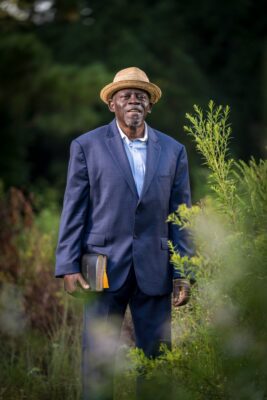 John Dortch believes in second — and third — chances.
The Beaufort native created Circle of Hope Ministries 15 years ago to offer homeless veterans a second chance at life with transitional housing and help finding a permanent residence. A veteran himself after serving as an infantry platoon leader in Vietnam with a medical discharge, he knew first-hand the importance of support for those returning from battle. The project was supported from its inception by a grant from the Coastal Community Foundation, and was successful enough to earn him the Beaufort County Ministerial Alliance’s Rev. Dr. Martin Luther King Humanitarian Award five years later.
Then the pandemic hit, and Circle of Hope was forced to shut down its dormitory-style group home and emergency shelter. At that time, it was the only transitional housing facility in Beaufort County for veterans. But John had faith in his vision to serve fellow veterans and began planning an even bigger community with more comprehensive services named Hope Village Inn.
Soon, the pieces began to fall into place. In 2022, he sold Circle of Hope’s property on Boundary Street to jump-start a capital campaign for a new facility. Another revenue stream began flowing with the opening of Veterans 1st Thrift Store at 612 Robert Smalls Parkway. The volunteer-run store provides free furniture and household goods for veterans transitioning from homelessness to their own residences, while also raising revenue from sales to the public to help finance construction of the new residential campus.
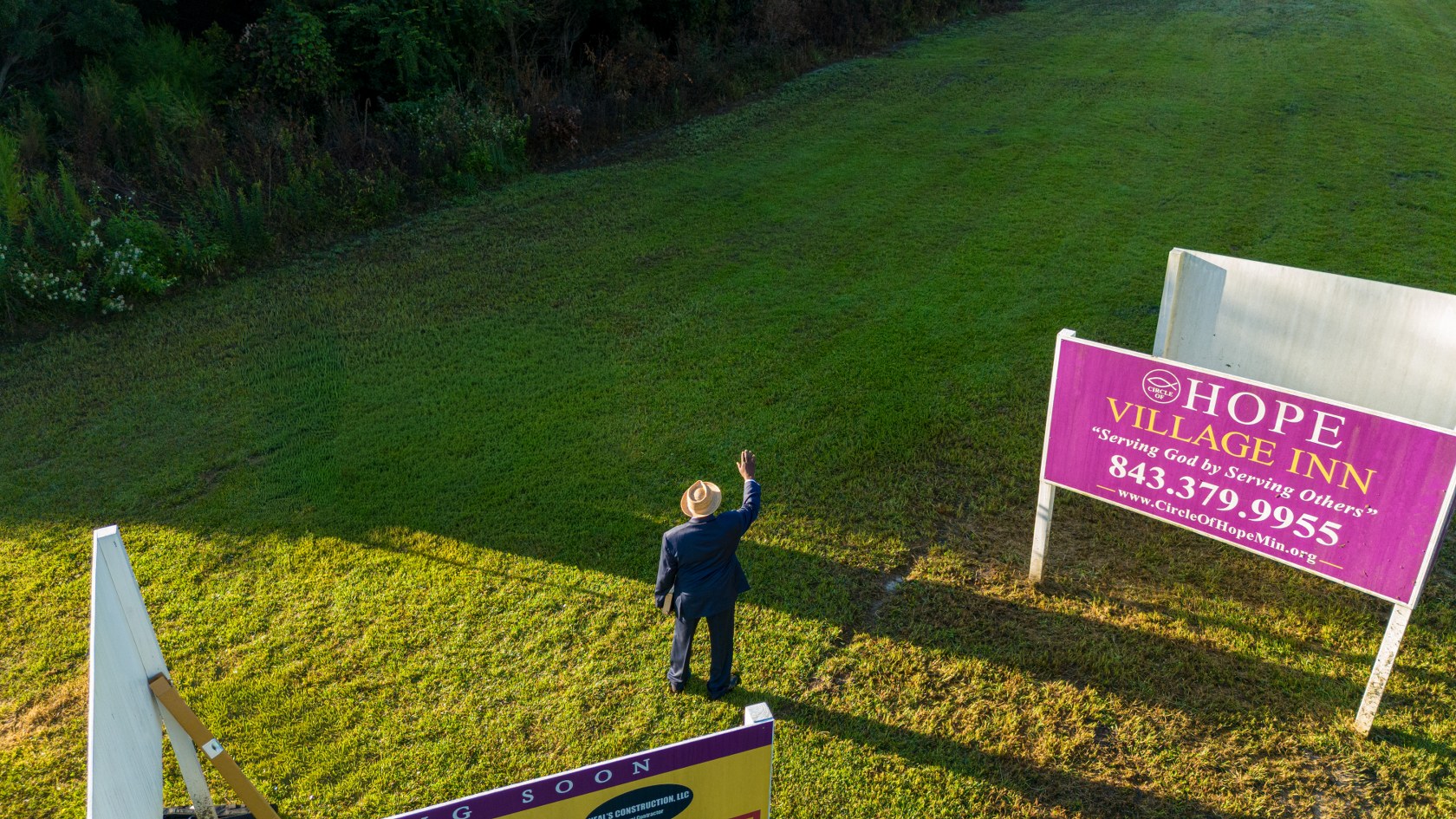
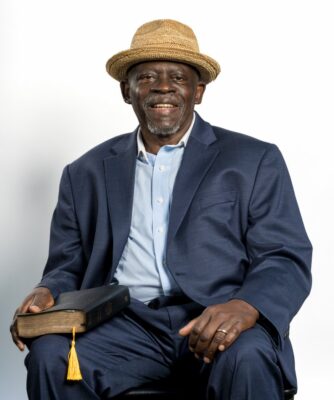 The Multi-Cultural Association of Beaufort helped drive the project forward by donating three-and-a-half acres of land at 201 County Shed Road in Burton as a site for the Hope Village Inn, along with a $25,000 grant. The same year, the Coastal Community Foundation provided a $100,000 grant from the Alan and Joanne Moses fund, and First Federal Foundation recently made a $10,000 grant. Circle of Hope also receives support from the Forgotten Sons Motorcycle Club, the Jasper-Beaufort chapter of American Bikers Aimed Toward Education, the Sun City Veterans Association and AMVETS Post 70 of Beaufort, as well as individual donors in the faith-based community.
John shares that the capital campaign fund has more than $300,000 on deposit and has spent about $200,000 for architectural and engineering services, permit fees and environmental impact studies. Now, with a construction loan application pending with First Federal Bank of Florida, he says that Circle of Hope is on the verge of putting the first shovels in the ground on the $5.2 million project.
Construction will take place in four phases and take about two years to complete. Phase one will include infrastructure for the entire the project and construction of two apartment buildings with five units each. One unit in each building will be compliant with the Americans with Disabilities Act. Phase two will include three cottages for families, with one ADA-compliant unit, and phase three will include three larger villas. Phase four will add a 5,000-square-foot multipurpose building with a commercial kitchen, laundry room, storage units, and an auditorium that will be open to other nonprofit organizations in the community for their programs.
“We hope to break ground this year, or at least within the next six months,” John declares. “I’m the perennial optimist.”
A PRODIGAL SON
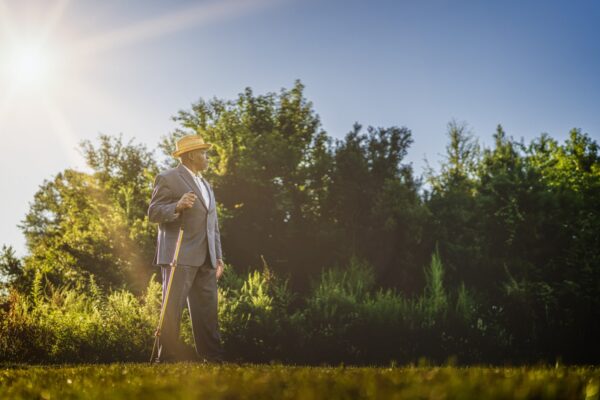
Those who know John’s backstory know his optimism has been tested more than once. He was born and raised in Beaufort by devout Christian parents. His father was a pastor and John accepted Christ when he was 11. John planned to join the Marine Corps after graduating from Robert Smalls High School in 1963, but says his mother insisted on college. He went on to Howard University, where he was active in the ROTC program and was designated a Distinguished Military Student. He received a regular army commission and was assigned to Fort Benning, Georgia, where he volunteered for Vietnam. His military career was cut short when he was injured while saving the life of a man under his command during a combat operation, resulting in a medical retirement as a first lieutenant.
John settled in Washington, D.C., after returning stateside, embarking on a successful career as a field underwriter for New York Life Insurance Company and eventually becoming the company’s top salesman in the D.C. area. But John dreamed of owning his own business, so after five years, he resigned to start a small investment company, JCD Enterprises. He recruited fellow Howard graduates to serve on the board of directors, and trained a team of young men and women to obtain their licenses to sell financial securities. His goal was to raise money for community investments, but the organization ran into a cashflow problem and was unable to honor its financial obligations. After futile attempts to raise capital from financial markets, John explained that he faced the painful prospect of declaring corporate bankruptcy and seeing his investors lose their money.
That’s when the story takes a bizarre turn. He decided instead to turn to patrons of a nightclub he owned to recruit a new team — to rob banks.
Spoiler alert: That didn’t end well.
“We planned like a precise military operation,” John says. “We had an inside person and knew the combination to the vault, the security system, and when the armored truck was arriving with the money. We thought we could get $1.5 million.”
But the police were tipped off by an informant and arrived at the bank just as John and an accomplice got out of their car. Both fled in different directions, but the accomplice shot and killed an officer who tried to arrest him. When John learned what happened, he turned himself in to police. In 1975, he pled guilty to second degree murder, conspiracy, and attempted armed robbery, and spent the next 15 years in a maximum security federal prison.
The next surprising twist in the tale came after his release, when despite a felony conviction and questionable financial decisions in his background, he was hired at a Washington, D.C., church as its business manager.
“I never lied about my background.” John says. “I always told the good, the bad and the ugly, and the church personnel committee voted unanimously to hire me. The pastor said, ‘If God has given you a second chance, who are we to deny you?’ I also taught adult Bible study and mentored at-risk youth.”
A year-and-a-half later, John left the church to attend law school, becoming president of the student bar association and class speaker at graduation. He passed bar examinations in D.C., Maryland, and West Virginia, and was hired by a law firm in West Virginia, even though he was denied bar admission because he was still on parole.
Then John’s story took another Hollywood movie-worthy turn when he was interviewed by Katie Couric on NBC’s “The Today Show.”
“That led to job offers from all over the country,” he says.
But despite his highly compensated position in the law firm, John says he again felt the pull of the ministry. He returned home to Beaufort, where he became an ordained deacon and a licensed minister, and then pastor of Central Baptist Church.
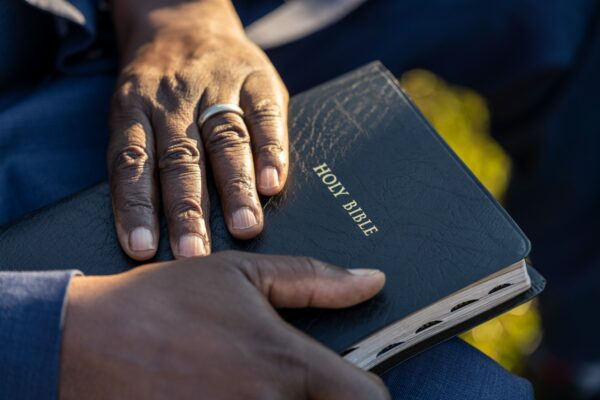
“I fell in love with the congregation, but after two years, I was moved in my spirit to pursue a vision God gave me 35 years earlier,” John says. “My calling is to be a doer of the Word: to feed the hungry, clothe the naked, shelter the homeless, minister to the sick, and visit the prisoners. God has not called me to be a traditional pastor. He’s called me to be out in the community where people are broken and to minister to them right where they are.”
John left his position at Central Baptist, and Circle of Hope Ministries was born — an organization he views as a “church without walls, serving God by serving others.”
DRIVING PASSION
“The men and women in the armed services sacrifice so much for our nation. We owe veterans a debt of gratitude that must be expressed, not only in words, holiday celebrations, and the singing of anthems, but with actions that convey our deep appreciation,” John says, explaining his focus on veterans as a priority.
His passion for veterans is authentic. In addition to his own service, several close family members served in Vietnam, returning home physically and mentally injured. His brother, William Dortch, was an Army pilot who served two tours in Vietnam and was awarded the Distinguished Flying Cross for valor during the Tet Offensive. He died at age 47 after suffering from post-traumatic stress disorder and health issues related to Agent Orange. A first cousin, Benjamin Smalls Jr., also served in Vietnam and was honorably discharged as a staff sergeant but died at just 24 due to medical complications caused by Agent Orange. John notes many other close friends were casualties of the Vietnam War, and many family members served in World War II and the Korean conflict.
After a long and nearly unbelievable journey, John may have finally found his way home.
“Look at my life,” he says. “I went through the fire, but now I’m in the best place I’ve ever been. Ministry is my reason for being. God has kept me for a purpose. I serve God by serving others.”
And at age 80 — a husband, father, grandfather and great-grandfather — he says he has no plans to stop, or even slow down.
“I’m just getting started,” he says. “I have all the time in the world that God gives me. It may have taken Noah 75 years to build the ark, and Moses served until he was 120. Amen? Amen!”

ABOUT CIRCLE OF HOPE MINISTRIES
Circle of Hope Ministries, Inc. is a 501(c)(3) tax-exempt, faith-based, public charity. The organization seeks additional financial support to strengthen its equity position, so it can secure a smaller mortgage for construction of Hope Village Inn at a lower rate, enabling it to minimize rental rates for veterans. Those interested can mail contributions to Circle of Hope Ministries, Inc., P.O. Box 554, Beaufort, SC 29901, or visit www.CircleOfHopeMin.org to learn more. A copy of John’s book, “Memoirs of the Prodigal Son, the Road to Redemption,” will be given to the first 200 donors who contribute $100 or more to the capital campaign.