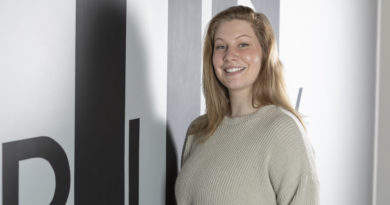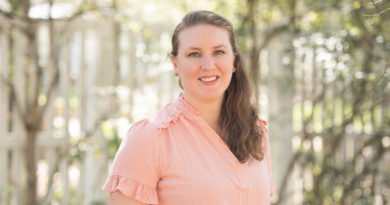
Julie McKay
TRIUMPHING OVER
EATING AND EXERCISE DISORDERS
story by JEANNE REYNOLDS photos by SUSAN DELOACH
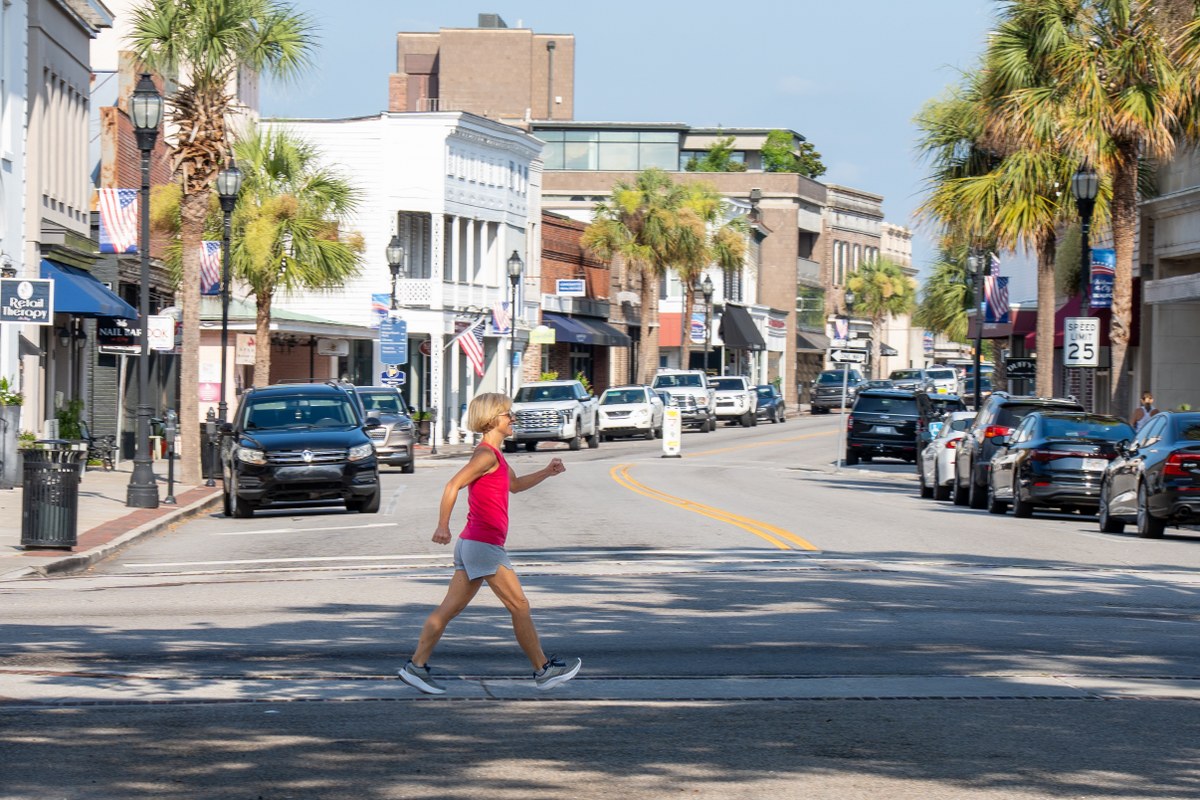
 If you’ve lived in the Beaufort area for very long and traveled around Lady’s Island, Port Royal, or Mossy Oaks, you’ve probably seen Julie McKay. She’s “The Walker” — the diminutive (we’re talking 4’10”) woman power walking through downtown, over both bridges, around Port Royal, on the Spanish Moss Trail, and up and down Sam’s Point Road and Sea Island Parkway, up to 10 miles a day, rain or shine, in sickness and in health.
“There are few days when I don’t run into someone who stops and asks if I’m the walker,” Julie says. “Some people have even referred to me as the ‘Ninja Bridge Walker’ and tell me how inspirational it is.”
Inspiring others to improve their health and fitness is clearly something Julie is proud of. But as Paul Harvey used to say, “And now … the rest of the story.”


THE UNSEEN STRUGGLE
Julie’s seemingly healthy commitment to fitness is actually a symptom of her lifelong battle with eating disorders and exercise addiction.
“My parents divorced when I was very young, and my mom became anorexic and ‘taught’ me,” she recalls. “An aunt once told me I was asking how many calories were in things at age 5. Most little girls want to be like their mom, and I idolized her and tried to do whatever she did. She encouraged me to exercise and try other diet tools over the years, even though I was never really overweight.”
Julie grew up in the Columbia area, living with her father and stepmother most of that time. She stayed fit with typical activities during her teen years, including dance, cheerleading, tennis, and piano lessons. After graduating from the University of South Carolina with a degree in secondary education teaching Spanish and French, she got married and moved to Charleston so her husband could attend medical school and also began her own teaching career.
She wasn’t on a regular exercise routine then, but wanted to lose a little weight. Unfortunately, with her early “training,” it wasn’t long before she found herself addicted to exercise and losing weight.
“In my early teaching days, I went on a longer anorexic kick, eating lettuce and a bowl of cereal most days while exercising to the extreme,” she says. “Exercising was my way of coping and escaping from the problems in my life, of staying in control.”
At first, her goal was to burn 1,000 calories a day with an hour on an elliptical machine. Then, to get out of the “unhealthy” gym environment, she started walking outdoors instead, from three to five miles up to 10, while “not eating much at all.”
Her eating disorder came and went over the next two decades as she battled marriage problems, through several different counselors and two hospitalizations during a three-year time period.
“It was wrecking my life,” she says. “I finally did residential treatment in Brevard, North Carolina, for a couple of months around 2007. I learned a lot of healthy habits about food that helped a lot with my mental battle, which still presents its ugly self sometimes,” she admits.


A PAINFUL SURPRISE
Julie moved to Beaufort in 2011 to be near her father and stepmother, who were enjoying retirement on Dataw Island, and began teaching at Beaufort High School. She continued to have some “weak moments with food issues” but rarely strayed from her eating plan — or her 10-mile daily walks. Then, unusual new symptoms started cropping up.
“I was having pain in my back, knees, and feet. After a while, doing 10 miles a day in the heat of the summer, I started experiencing a lot of pain in my sacrum and had a lot of issues with sciatica, but I continued to push through with my exercise regardless,” she says. “I went through chiropractic care and physical therapy a few times, and was a regular at my orthopedist’s office. We chalked it up to overuse injuries.”
She tried switching to rollerblades as a lower-impact alternative to walking, but in 2017 injured her shoulder in a bad fall. That turned out to be a blessing in disguise when an MRI revealed signs of stage 2 multiple myeloma.
“Those pains were from bone lesions — holes in my bones,” she explains. “After I started cancer treatment, the pains subsided.”
A stem cell transplant followed in 2018 at the Mayo Clinic Hospital in Jacksonville, Florida. She continues to get infusions locally and chemotherapy at Mayo every three months. Throughout her diagnosis and treatment, she’s continued to exercise daily, although a recent clavicle fracture — most likely due to her cancer — has sidelined her walking for a bit.
“It takes a lot to get me to not exercise every day,” Julie says. “I walked 5 miles a day while still in the hospital after the transplant — that’s a lot of laps around a hospital ward! The treatments drain my energy, but I’ve continued walking. The doctors say it’s the best thing for me. I won’t necessarily ever beat this cancer due to the nature of the beast, but because of my healthy lifestyle, I’ve had so few issues and never got sick like most people experience.”

WALKING THE PATH FORWARD
Julie’s mother died three years ago after developing early-onset dementia — another dark cloud with a tinge of silver lining. The dementia eventually caused her mother to stop exercising and start eating without restraint.
“That sort of gave me permission to ease up on my own ongoing, though not so active, battle with anorexia, to give myself some grace,” she says. “I still walk or do the elliptical every day and follow a healthy eating regimen, but I’m enjoying the freedom this has given me with not having to be quite so rigid with the speed, distance, and food choices.”
Julie has also begun a new chapter in her life as a retiree. “I want to do something ‘not teaching,’ but plan to stay in the school district, working with new teachers as a mentor,” she says. “I want the flexibility to help my parents, volunteer more, and serve as a phone coach for other myeloma patients.” She’s also added yoga and tap dancing to her active pursuits.
“I’ve continued to maintain a good balance with staying healthy, but it’s been a struggle,” she says. “People say I inspire them, but they don’t know what’s really going on. If they knew the back story, it might make even more of a positive impact — and that brings me joy. Knowing I can give others a little hope with their own battles through my story is what helps keep me going, too. Above all, I give the glory to Jesus. My faith has kept me strong and determined.”
JULIE’S LIFE LESSONS LEARNED THE HARD WAY
• Be more flexible.
• Rome wasn’t built in a day. One day off, or eating a piece of cake, isn’t going to make or break you.
• Stay in the moment. Be more present, and slow down and experience more. Find things you’re passionate about.
• Life is short. You really don’t know what’s going to happen, as I found with my cancer.

JULIE’S TIPS FOR HELPING SOMEONE WITH EATING OR EXERCISE DISORDERS
If it’s you
• “Get help. Find an accountability partner or you’ll be stuck forever. And it’s not a fun place to be stuck in. I’m my own advocate now because I’m aware of what I’m doing. Sometimes I’ll see someone really thin and think, ‘I wish I could be like that,’ but I know what goes with it, and it’s not a fun place to be.”
• “When I was hospitalized and battling anorexia early on, they frequently reminded me as I was ‘learning’ to eat again that ‘food is medicine.’ I had to constantly remind myself of that and it became my mantra for quite a while.”
If it’s a loved one
• “Approach it as acknowledging the internal pain he or she must be experiencing and note the first goal is to get that loved one in a healthier place physically and medically. Don’t focus on food or eating — a mere band-aid — as much as the medically safe side.”
• “Figure out the root cause of the behavior and approach it lovingly. Enlist professional help. Counseling, including family counseling, is a start. Ask questions and listen so you can understand.”