Dr. Juanita Babet Villena-Alvarez
BREAKING BARRIERS
story by CAROL WEIR photos by SUSAN DELOACH
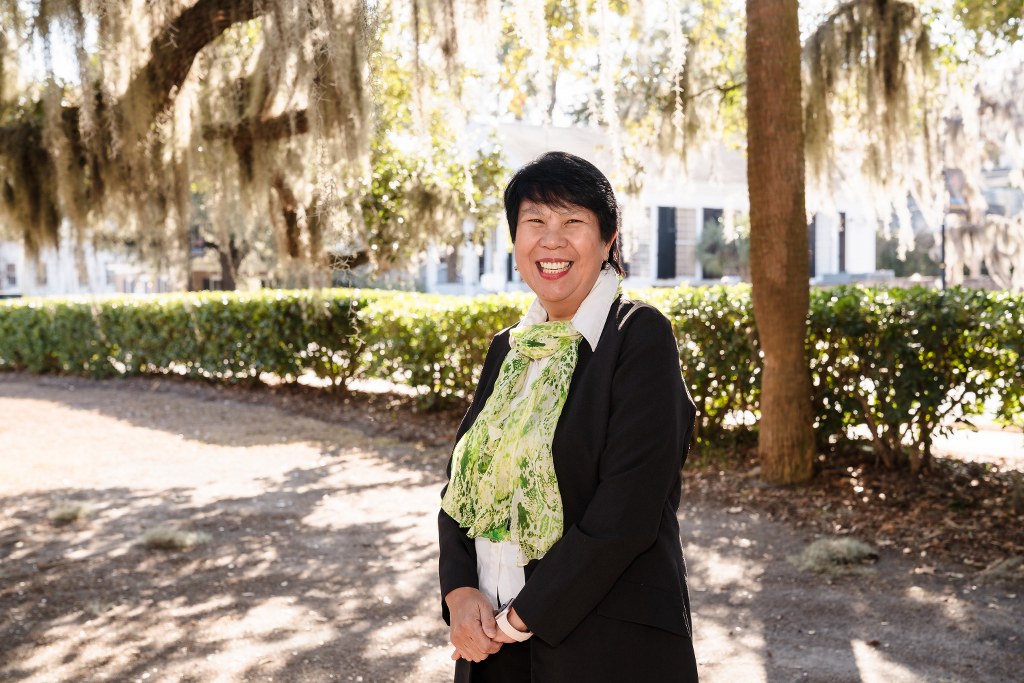
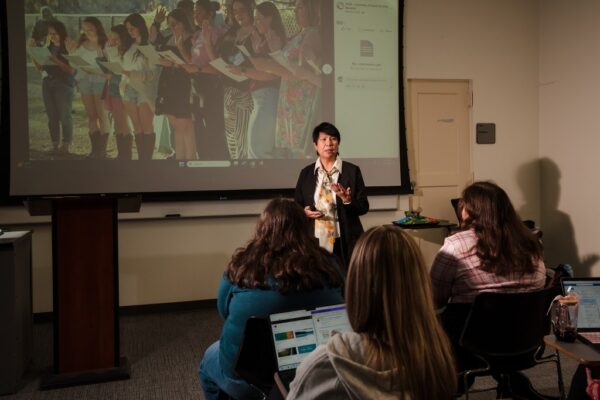
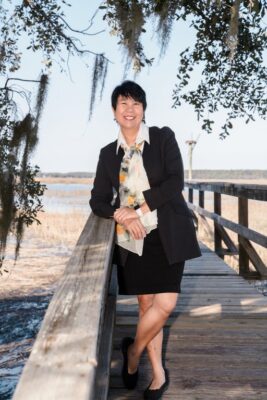 “Babet” to her friends and “Dr. A” to her students, Juanita Babet Villena-Alvarez, PhD, is the University of South Carolina Beaufort’s Associate Vice Chancellor for International and Academic Engagement. She led USCB to its first national award with the American Association of State Colleges and Universities (AASCU). She directs the university’s international and honors programs, and teaches French, Spanish, and Global Studies.
You’ve been at USCB since 1994 — the longest-serving employee on campus. Who is Babet Alvarez beyond the titles?
I came to Beaufort and USCB thanks to Dr. Larry Rowland, who hired me when I was very young. I’ve traveled a long distance to get here — geographically, culturally, economically, and intellectually. I was born in what was then a small mountain town in the northern Philippines, educated in Europe, and then I immigrated to the United States. Today, I’m an American who wakes up every day asking, “How can I remove barriers for students, faculty, and this institution?”
I started college at 16 and by 20 was already teaching five courses at the University of the Philippines Diliman. My dean and professors worked together to help me find extra teaching so I could afford a plane ticket to Spain, where I had been offered a scholarship for a master’s degree. Imagine that — your own professors scrambling for you. That experience shaped me. It’s why I work so hard to find opportunities for my students now.
Your academic journey spans multiple countries and degrees. How did that unfold?
Scholarships made everything possible. A Spanish government grant brought me to Spain, followed by a Rotary Foundation Ambassador of Goodwill Scholarship — only one person from the Philippines received it that year — to complete my Magistère at the Sorbonne in Paris. A partnership between the Sorbonne and the University of Cincinnati allowed me to convert my degree to an American master’s and continue on to a PhD in French Literature.
So yes — the equivalent of three master’s degrees and a PhD, all funded by people who believed in investing in potential. That generosity drives how I mentor students today.
Your path hasn’t always been easy. How would you describe the journey?
Bumpy. Rough. Adventuresome. Scary. Exhilarating. Tiring. Rewarding.
Barriers make you stronger if you don’t let them stop you. Doors close — I look for another one. Sometimes people try to diminish your work. That can hurt, but it motivates me. When someone says something can’t be done, I get energized proving that it can.
 You’re known for pushing USCB students and faculty toward big national and international grants. What keeps you going?
I want to see how far I can help others go. That’s the honest answer.
Once, someone questioned how I could serve as USCB’s Fulbright Advisor when I had never personally received a Fulbright. Well, guess what? We’ve since guided multiple students and faculty to Fulbright/Fulbright-Hays awards, and USCB has been named a Fulbright Top Producing Institution twice.
You’ve received major recognitions yourself. Which accomplishments are closest to your heart?
The South Carolina Governor’s Professor of the Year award in 2010 means a lot — there’s a tree planted beside USCB’s Hargray Building in my mother’s honor because of it. Also, the Carolina Trustee Professorship I received in 2012.
I’m also proud of the opportunities we’ve created for students: our Poland pre-med study abroad program, Fulbright-Hays initiatives, support from the French Embassy, and the many Carolina Trustee Professorships our campus has earned. All these partnerships open doors.
You’ve powered through serious health challenges. What were they?
In 2003, my doctor — Dr. Tim Pearce, who has treated half of Beaufort— told me, “You should be dead by now.” I had a ruptured appendix and kept teaching for two weeks. Dr. Jane Upshaw, who was Dean then and later became USCB’s first Chancellor, visited me in the hospital. She said, “What were you thinking?!” I guess I was thinking about my students. Not the smartest moment — but very on brand. As a child, I had many sore throats that eventually led to permanent hearing loss. I didn’t realize I needed hearing aids until I was in college. Sometimes I tell my family and my students, “Please wait a moment. I need to put in my ears!”
 Tell us about your family. They seem central to your life.
My daughters are the lights of my life. Natalie is a PhD student in Molecular Genetics at Emory University. Our youngest, Marie Sophie, is thriving at the South Carolina Governor’s School for Science and Math. The sky’s the limit for them, and I couldn’t be prouder.
My family is my safe place and where I let my hair down. I grew up in a family of six women — my mom and four sisters. Believe it or not, I was considered the quiet one! We’re now spread out across the U.S., but we visit each other often and stay close despite the distance.
My mother, Mila, has lived with me for nearly 20 years. She’s 92 and has created a mini-Philippine backyard farm of Asian vegetables and fruit trees in our neighborhood. We live in Cottage Farm, near Beaufort Memorial Hospital, and we love it there.
Tending her garden keeps my mom strong — and keeps us (and our friends!) all well fed.
How did you meet your husband? Do you have similar temperaments?
I met Butch in Ohio when I was a graduate student. He is the calm to my five-directions-at-once energy. He’s a physician by training but focuses on teaching and mentoring, especially with students interested in health professions. USCB students call him “Mister Dr. A.” We both put in long hours at USCB. Every fall, we help at the dorms on move-in day, hauling boxes up the stairs and getting very sweaty. It’s one of our favorite traditions — meeting families, calming nerves, and welcoming students.
Your cooking is legendary. Where did that passion come from?
From my mom — and from the world. I learned in her kitchen as a child and then blended in flavors from Spain, France, Poland, Korea, and beyond. I don’t cook one cuisine — I cook stories.
I marinate meats overnight, mix Filipino flavors with Korean sesame oil, add Spanish garlic techniques, and make French crêpes stuffed with Polish-style fillings. Food is love, travel, and culture on a plate.
When you’re not working, how do you relax?
I used to spend a lot of time alone reading, but lately I prefer to be with people I love. I love traveling with family, cooking together, talking to my daughters on the phone, watching K-dramas with my mom, and gardening with her. There’s a line from Voltaire’s Candide: “Il faut cultiver notre jardin” — we must cultivate our garden. Beaufort turned out to be the ideal place for me to set down roots and grow. Resources abound here. If we believe in ourselves and work hard, we can make the most of opportunities for ourselves and others.